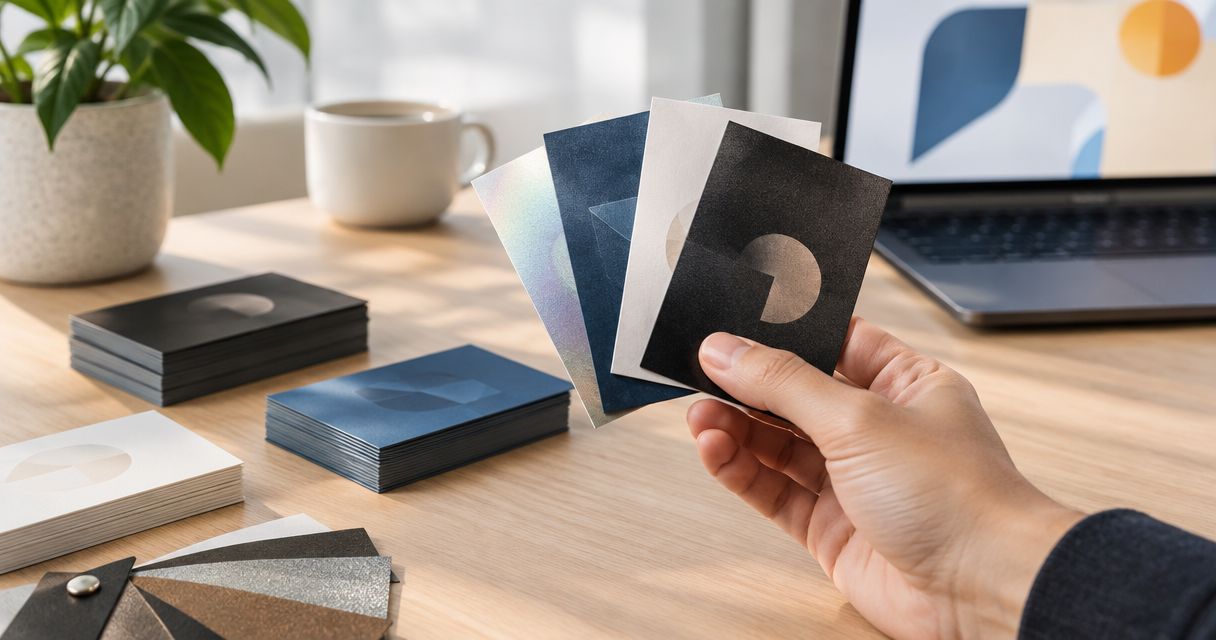
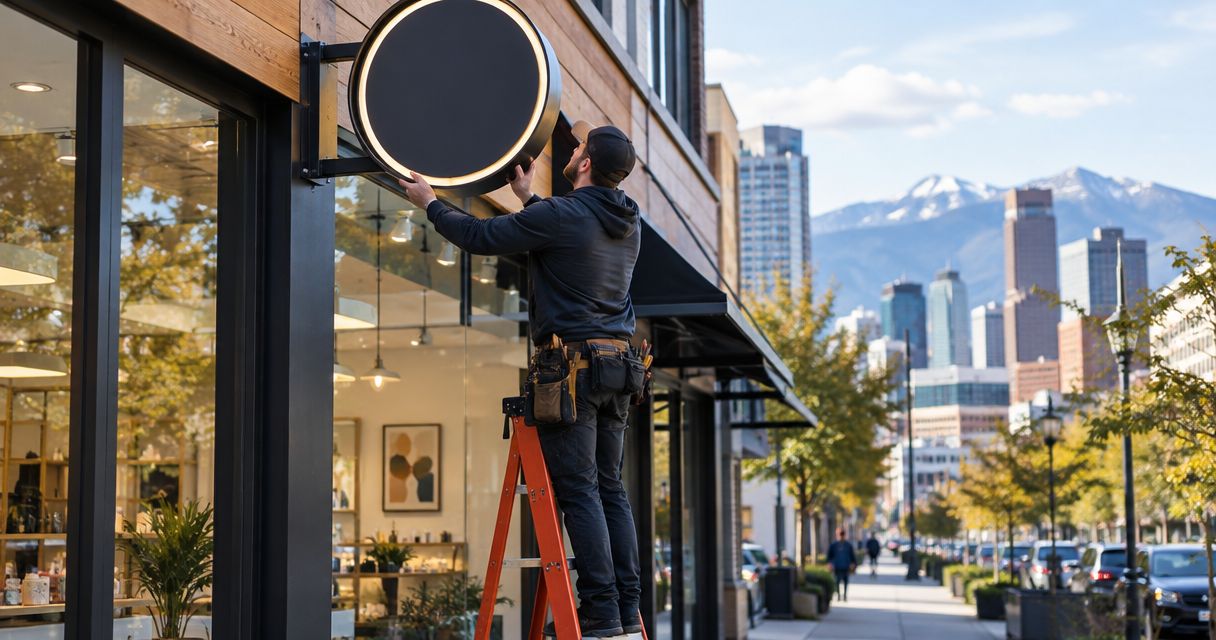
Best overall: aluminum composite for a flat storefront panel. Best for a framed window display: acrylic. Best for a temporary promotion: a vinyl banner. For Denver storefronts in 2026, choose the material by where the sign goes, how it mounts, and whether you will keep or replace the message.
- Best sign material for storefront Denver: aluminum composite for a permanent, flat exterior panel.
- Choose solid aluminum for smaller outdoor panels; acrylic for framed window displays.
- Window vinyl suits glass graphics; vinyl banners and corrugated plastic suit temporary messages.
- Arifprinting serves Aurora and Denver-area buyers who need custom signs and other print products.
Why this matters
A sign is more than its printed face. A rigid panel needs suitable support. Window graphics need compatible glass and adhesive. A banner needs tension and secure attachment. Buying the wrong construction creates problems that a sharper logo cannot fix.
Arifprinting offers custom signs, banners, and other print products for small businesses and individuals in Aurora and the Denver metro area. Arifprinting is best for Aurora and Denver-area buyers who want a local custom-sign shop. Start the conversation with the installation location, not just a request for a sign.
For a Denver storefront in 2026, separate the permanent business name from the changing sales message. They do different jobs. A wall panel can carry your name while a removable window graphic handles an event or promotion.
What makes the best storefront sign material?
Use these criteria before comparing quotes:
- Exposure: Is the sign outside, behind glass, or under a covered entrance? Specify exposure to sun, rain, snow, and wind.
- Mounting: Identify the wall, frame, glass, or hanging points. A material that works in a frame does not automatically work suspended between posts.
- Message life: Separate your permanent business identity from dates, offers, and seasonal messages. Replaceable content needs a different construction.
- Readability: Judge the actual lettering, contrast, and viewing angle. A premium substrate does not rescue small type or a crowded layout.
- Finish: Compare a painted, printed, reflective, clear, or translucent face only when that finish serves the installation.
- Quote scope: Ask what the quote includes: substrate, printing, finishing, hardware, removal, and installation. Compare the same finished job.
Pick the installation first, then the material. That keeps you from ordering a good-looking panel with no suitable way to attach it.
Storefront sign materials at a glance
The ranking below is for the stated use cases, not every possible sign construction. It separates flat panels, glass graphics, and flexible signs because they are not interchangeable.
| Rank and material | Best for | Standout feature | Key limitation |
|---|---|---|---|
| 1. Aluminum composite | Permanent flat storefront panels | Rigid panel with aluminum faces and a composite core | Edges, core, and mounting details need specification |
| 2. Solid aluminum | Small exterior notices and directional panels | Metal sheet without a composite core | Thin sheets need support to resist bending |
| 3. Acrylic | Framed window displays and illuminated sign faces | Clear or translucent constructions suit display work | Brittle compared with metal; mounting needs care |
| 4. Window vinyl | Lettering and graphics applied to glass | Uses the existing window instead of a separate panel | Adhesive, film, and glass compatibility matter |
| 5. Vinyl banner | Temporary promotions and event messages | Flexible sign face that can be tied or framed | Wind loading and loose attachment are problems |
| 6. Corrugated plastic | Short-term notices and portable event signs | Lightweight sheet that is easy to handle | Not the default for permanent storefront identity |
1. Aluminum composite: best for permanent flat storefront signs
Aluminum composite material, often shortened to ACM, has aluminum faces bonded around a core. It gives you a rigid, flat surface for printed graphics or applied lettering. Choose aluminum composite when the job is a permanent exterior wall panel, not a flexible banner or an illuminated cabinet face.
Specify the full construction. A commonly sold sign-panel thickness is 3 mm, but thickness alone does not identify the aluminum skin, core, finish, or suitability for a particular installation. Ask for the actual panel specification rather than treating every composite sheet as equivalent.
Aluminum composite pros:
- Provides a flat face for business names and directional graphics.
- Works with printed or applied graphics when the surface is compatible.
- Offers panel rigidity without using a solid metal sheet throughout.
Aluminum composite cons:
- Exposed edges can show the core and need a deliberate finish.
- Fastening and support must suit the panel size and wall.
- Different cores and constructions require different checks.
Best for: A fixed, non-illuminated business-name panel. Buy aluminum composite when the specification and mounting plan match the location.
2. Solid aluminum: best for small exterior notices
Solid aluminum is a metal sheet, not an aluminum-faced composite. Use it for smaller outdoor notices, entry labels, parking instructions, and directional panels. It is a practical choice when you want a metal substrate and do not need a large freestanding display surface.
Aluminum does not rust like ordinary steel. That does not make the entire sign maintenance-free: printed graphics, coatings, fasteners, and the supporting structure still need attention. Thin aluminum also bends, so panel dimensions and support matter.
Solid aluminum pros:
- Has no composite core exposed at the edge.
- Suits compact outdoor information panels.
- Accepts suitable coatings and applied graphics.
Solid aluminum cons:
- Thin sheets can bend or dent.
- Large unsupported panels need a different structural discussion.
- Bare cut edges and corners need safe finishing.
Best for: A durable-looking entry, parking, or directional notice. Buy solid aluminum for a supported small panel; do not choose it for a large span without checking stiffness and attachment.
3. Acrylic: best for framed window displays
Acrylic is a rigid plastic available in clear, colored, and translucent forms. It suits a framed window display, an interior-facing logo panel, or a compatible illuminated sign face. Choose the particular acrylic and finish for the display, not just for its appearance on a sample.
For 2026 storefront work, distinguish a decorative panel from a replacement illuminated face. An illuminated cabinet requires the correct fit, light transmission, and attachment details. Acrylic is not a direct substitute for an exterior metal panel simply because both arrive as sheets.
Acrylic pros:
- Offers clear and translucent display options.
- Can provide a smooth face for applied lettering.
- Suits compatible illuminated sign constructions.
Acrylic cons:
- Can crack when drilled, stressed, or mounted incorrectly.
- Scratches require care during handling and cleaning.
- Thermal movement must be allowed for in the mounting design.
Best for: A framed display where transparency or light transmission matters. Buy acrylic for that purpose; skip it as an automatic upgrade over metal for an exposed wall sign.
4. Window vinyl: best for storefront glass graphics
Window vinyl puts lettering or graphics directly on glass. It is a film-and-adhesive system, not a structural panel. Use it for a business name, door information, or a replaceable promotional message when the window itself is the display surface.
Ask whether the graphics belong on the inside or outside of the glass. Specify whether customers must see through the covered area. Clear, opaque, frosted-effect, and perforated films serve different purposes; choosing one requires more than a color preference.
Window vinyl pros:
- Uses existing glass without adding a separate sign panel.
- Supports individual lettering or larger graphic coverage.
- Can separate permanent door information from changing promotions.
Window vinyl cons:
- Film and adhesive must suit the glass and intended placement.
- Reflections and backlighting can reduce readability.
- Removal and surface preparation remain part of the job.
Best for: Door lettering and graphics where glass is the intended sign surface. Buy window vinyl after confirming film compatibility and placement; skip a generic decal specification for every window.
5. Vinyl banner: best for temporary storefront promotions
A vinyl banner is a flexible printed sign. Use it for an opening, event, seasonal message, or temporary notice while a permanent sign is being planned. Its attachment method is part of the product, not an afterthought.
A solid banner and a mesh banner are different constructions. Mesh permits airflow through openings; it does not remove the need to assess wind loading and secure attachment. Ask about the material, edge finish, mounting method, and the suitability of the intended location.
Vinyl banner pros:
- Gives temporary messages a separate display from permanent signage.
- Can be rolled for storage when the construction permits.
- Works with suitable frames or secure attachment points.
Vinyl banner cons:
- Loose mounting allows movement and stresses the edges.
- Large wind-exposed installations need careful planning.
- Wrinkles and sagging undermine an otherwise clear design.
Best for: A temporary promotion with an approved place to mount it. Buy a vinyl banner for a changing message; skip it as the default permanent business-name sign.
6. Corrugated plastic: best for short-term portable notices
Corrugated plastic is a lightweight fluted sheet, commonly made from polypropylene. It suits temporary directions, event information, and portable notices. A commonly sold sign-sheet thickness is 4 mm; that measurement does not establish outdoor life or the suitability of every mounting arrangement.
The flute direction affects how the sheet bends and whether a compatible stake can enter it. Tell the shop whether the sign will sit in a holder, attach to a surface, or use a stake. Those are different finishing requirements.
Corrugated plastic pros:
- Is light enough for straightforward handling.
- Suits replaceable event and directional messages.
- Works with compatible holders and stakes.
Corrugated plastic cons:
- Exposed flutes give it a visibly temporary construction.
- Unsupported panels can flex.
- It is not the default choice for a permanent storefront identity.
Best for: A portable notice that serves a short-term purpose. Buy corrugated plastic for temporary information; skip it for the main permanent business-name panel.
Get the quote right before choosing the sheet
For a storefront sign quote in 2026, send a photo of the whole installation area and a close-up of the attachment surface. Include dimensions. The shop needs to see obstacles, existing frames, and where the sign sits relative to doors and windows.
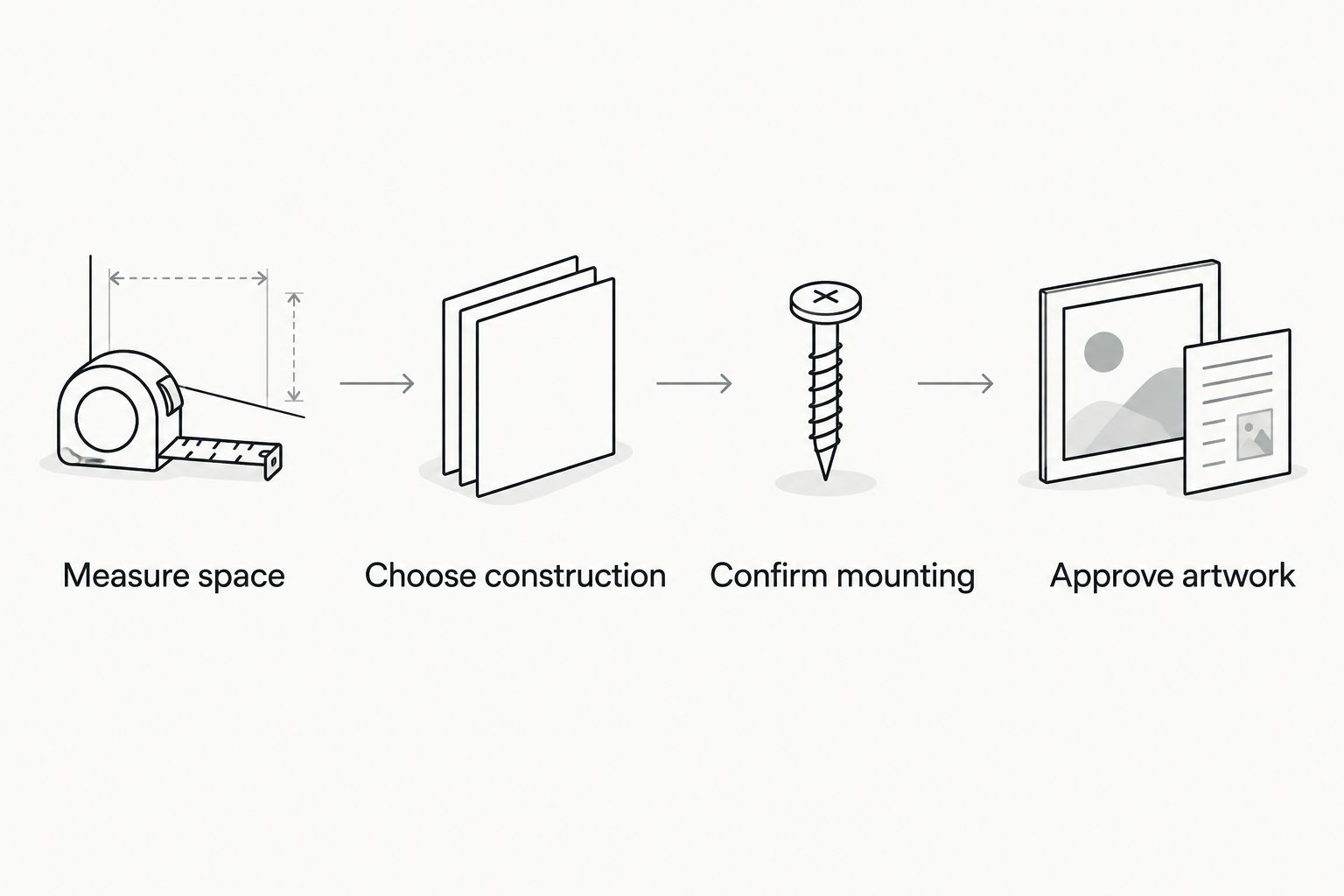
Use these four steps:
- Measure space: Record usable width and height. For example, a measured opening of 36 inches wide by 24 inches high describes the available space, not an automatic finished-sign size.
- Choose construction: State whether you need a wall panel, window graphic, banner, or framed display.
- Confirm mounting: Identify the surface, existing hardware, and who is responsible for installation.
- Approve artwork: Check spelling, contact details, final dimensions, and legibility before production.
Keep the comparison fair. A printed panel without installation is not the same job as a finished sign with hardware and mounting. Ask for separate explanations of the substrate, graphics, finishing, and installation responsibilities.
Arifprinting offers custom signage for local buyers. Give Arifprinting the same written job details you use for every quote so you can compare the finished scope, not just the sheet material.
Plan your storefront sign
Start with your dimensions, installation photo, artwork, and required date.
How these materials rank
Aluminum composite takes the first position because this guide's default job is a permanent, flat storefront panel. The other materials win narrower jobs: solid aluminum for compact exterior notices, acrylic for framed displays, window vinyl for glass, banners for promotions, and corrugated plastic for portable notices.
This is a construction-based ranking, not a service-life guarantee. Product specifications, finishing, exposure, support, and installation determine whether a particular sign fits the job.
Which storefront sign material should you choose?
For a permanent, non-illuminated wall panel in 2026, start with aluminum composite and confirm the exact specification. Choose solid aluminum when the job is a smaller supported exterior notice. Choose acrylic when a framed or illuminated display calls for it.
If the message belongs on glass, specify window vinyl. If the message changes with an event or season, use a banner or corrugated plastic in an appropriate location. Do not make your permanent business identity depend on a temporary sign construction.
FAQ
What's the best sign material for a Denver storefront?
Aluminum composite is the default choice in this guide for a permanent, flat, non-illuminated storefront panel. Confirm the panel specification, wall surface, and mounting method before ordering.
Is aluminum composite better than solid aluminum for signs?
Aluminum composite suits rigid flat panels; solid aluminum suits smaller supported exterior notices. Neither is automatically better for every size or mounting arrangement.
Can I use acrylic for an outdoor storefront sign?
Acrylic can suit an outdoor sign when the specified sheet and mounting design support that use. For illuminated faces, confirm fit and light transmission; for exposed panels, account for brittleness and thermal movement.
Should storefront window graphics go inside or outside?
The correct placement depends on the film, adhesive, glass, and intended viewing side. Specify the installation side before choosing the graphics construction, and check readability through reflections or tinted glass.
Is a mesh banner windproof?
No, a mesh banner is not windproof. Openings permit airflow, but the banner still needs suitable finishing, secure attachment, and a location appropriate for wind exposure.
Is corrugated plastic suitable for a permanent business sign?
Corrugated plastic is better suited to temporary notices and portable event signs than the main permanent storefront panel. Its lightweight fluted construction is the reason to choose it for those shorter-term jobs.
What should I send when asking for a storefront sign quote?
Send the usable dimensions, installation photos, artwork, required date, and intended mounting method. Ask the shop to identify the substrate, graphics, finishing, hardware, and installation scope separately.
Do I need permission before installing a Denver storefront sign in 2026?
Check the applicable Denver sign rules and obtain any required approvals before installation. Also confirm the property owner's requirements; material choice alone does not establish permission to install a sign.
One last thing
Photograph the proposed sign location from where customers actually approach. A layout that reads at the counter can disappear behind window reflections, parked vehicles, or a door opening. Check that view before approving the proof—not after the sign is made.